|
| Original Gravel
Crunchers Page |
|

The ideal
in the barefoot world is a barefoot
horse who can handle extremes
in terrain... a horse that can
move easily across rock, sand,
mud, and water.
The epitome of barefoot soundness
is the "gravel cruncher",
a horse who moves easily through
the worst rock - the jagged
shale that litters steep single
track trails and paves most
parking lots, driveways and
dirt roads.
The assumption in recent times
has been that most domestic
horses are incapable of having
tough, durable feet, because
"good footedness"
has been bred out of domesticated
horses.
Mustangs are famous for their
great feet, but everyone says
that Thoroughbreds and Quarter horses
have horrible feet.... but we
know for a fact that they can
have some of the best feet in
a barn.
But even barefoot fanatics
are skeptical about the mythical
"gravel crunchers",
bare feet that can go anywhere,
do anything....
|

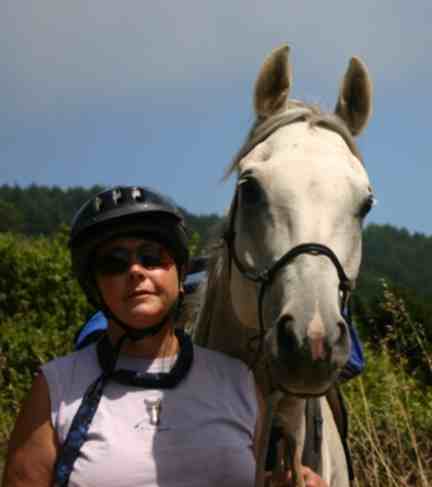
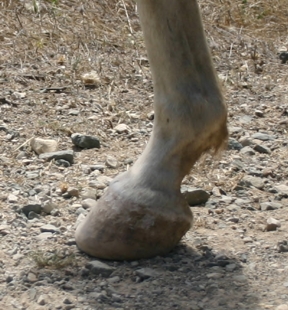
Cagey, 10 year old Arab |
|

Cagey |
About
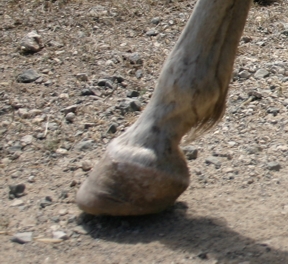
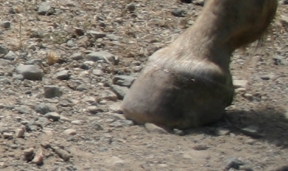
these dramatic "Gravel
Crunching" pictures...
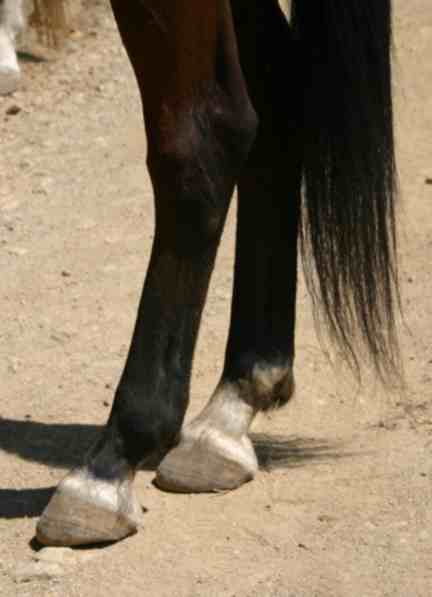
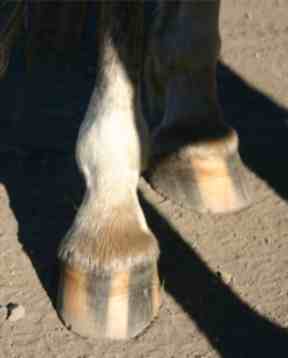
The horses depicted in these
pictures are all eager and willing
trail horses with very, very
sensitive, if durable, feet.
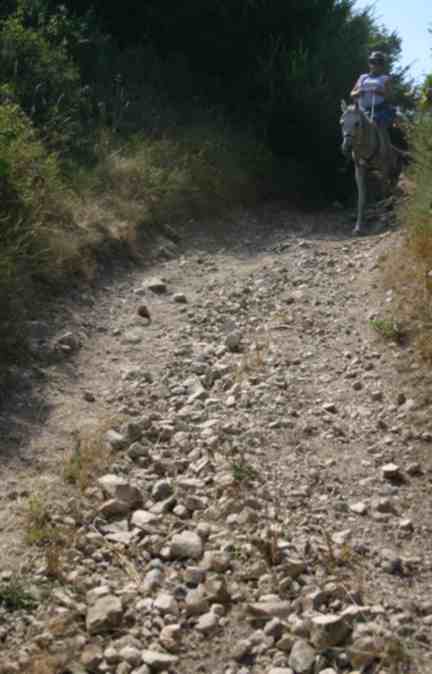
These pictures are taken on Coast Trail at Point Reyes National Seashore during a
24 mile - barefoot - ride,
and the horses are so casual
about the rocky environment that they
had to be slowed down
for me to take the pictures...
so no, moving over rock at a
decent speed isn't a problem
- unless someone's trying to get good
pictures!
I laughed when I had to
send Danielle and Nicole back
up a piece of trail repeatedly
because their horses strolled
over it like it was soft arena
sand and were too fast for me to get these pictures!
These horses and riders aren't
stupid; ridden on a loose rein,
barefoot horses avoid rock if
there is an alternative, and
while we trot trough rough trail,
we let the horse set the pace
and don't interfere with where
they walk.
Most of the trails we typically
ride barefoot on is a mixture
of great footing to rock littered,
and some of the trails in these
photographs are extremes. The
trail to the left is fairly
typical; it's littered with
rock but horses can easily place
their feet on good trail at
a trot without changing their
gait. On a 20 mile ride, most
of the trail is rock littered
( gravel road, like the trail
pictured to the left), some
of the single track is smooth
without a lot of rock, and a
mile or two is like what is
pictured below -- very rocky!
When riding on trail that starts
bothering our horses movement,
we either pull out the boots
or change trails! The trails
that slow us down barefoot should
slow down a shod horse, too,
because that narrow band of
1/4 inch metal can't protect
a horses feet from severe stone.
Epics offer excellent protection.
They take 3 minutes a set to
put on, and they stay in place
in all conditions. Riding booted
is just as cool as riding barefoot!
My horse almost never needs
rear boots, but I do carry rear
boots when his feet are extremely
wet and soft and the terrain
is extremely rocky. I'll update
this page with some Epic pictures
in the near future.
|
|

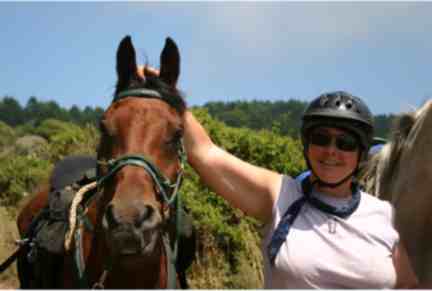
Robby, 12 year old Arab

Tinker, an 18 year old shetland
pony |
Developing
a gravel cruncher foot
My horses had been barefoot
for going on 2 years when I
asked Pete Ramey if he felt
that any horse could develop
a "gravel crunching"
foot, and explained that I kept
my horses on flat grassy flood
irrigated pastures, and that
I dreamed of riding bootless
on gaveled trails and fire roads.
Martha Olivo explained the
concept of passive conditioning.
She advocated the use of rock
around watering tanks, gates
and feeding areas, and quoted
Xenophon on horse management
for the development of rock-hard
feet. I boarded my horse at
the time and I wasn't in control
of my environment.
Pete's answer thrilled me;
he stated that in his experience,
almost all horses could develop
these tough "gravel cruncher"
feet, even with my irrigated
pasture conditions, as long
as some form of passive conditioning
- like a gravel pit or a hard,
flat dry lot - was integrated
into his environment in a way
that it got lots of use, AND
as long as the horse got lots
of regular exercise in a good
set of boots. Pete stated that
hard, flat surfaces like hard
pasture and paddocks were excellent
conditioning surfaces, and that
riding for long distances in
hoof boots was excellent conditioning
for building "gravel cruncher"
feet. Please read Pete's articles
on www.hoofrehab.com
for LOTS of great information!
When I moved to Sonoma County
and could have my horses home
again, I had a chance to implement
a gravel loafing area. (See
Passive
Conditioning). Their wandering
was limited to a 40x100 foot
paddock built on a 14 degree
slope, but the footing was hard
enough (lots of shale in the
soil) and the ground drains
well.
With a park 4 miles away? We
started getting in lots of riding!
|
|
Building
A Foot For Rocky Trails
It requires a lot of time and
travel to condition feet that
can handle rocky trails as easily
as the horses in these pictures.
But while the process takes
time and riding, it isn't difficult...
the hoof training is doing as
much riding as you can fit in
in riding boots.
I use EasyCare Epics pro protection
and competition, and have put
a lot of miles on a set of Boas
as well. Other people I know
like the Old Macs (also part
of the EasyCare line now) and
the Marquis boots.
Sonoma County has lots of rocky
trail, so my guys had to either
develop great feet or be booted
in the front. I'm 3 miles from
Armstrong Woods and Austin Creek
Parks, and not far from Annadale
and Point Reyes National Seashore.
Some of this trail is easy on
bare feet, but most of the trail
at Armstrong, Annadale and Austin
Creek has a considerable amount
of sharp shale.
I started Gavilan out in boots
because he couldn't handle all
the rock and because I planned
to ride him in endurance booted
anyway. Shatirr and Kadance
were left unbooted because their
feet had been left natural longer
so were tougher, and I would
be ponying them most of the
time.
Gavilan's booted feet had gotten
very tough by June of this year
(3 months into my "gravel
cruncher" hoof conditioning
program), and when I rode him
bootless on a camping trip to
Jack Brook Horse Camp and was
able to trot and canter all
of Old Haul Road barefoot, I
realized that the boots had
done their job - Gavilan has
awesome feet! I still boot him
if he feels tender or if I want
to travel at speed on really
rough roads, but he files over
rocky trails as if he has wings
on his feet. |
|
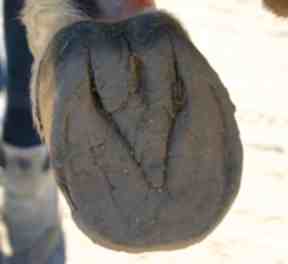
The
Shape of a Healthy Bare Foot
So I've started looking at
robust bare feet, taking pictures
and recording histories, because
now I know that the "gravel
cruncher" isn't a myth.
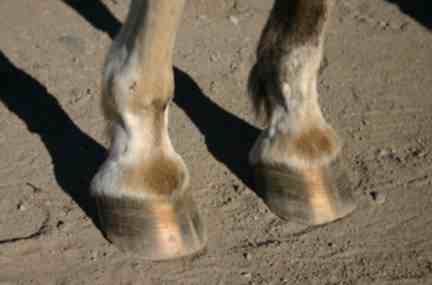
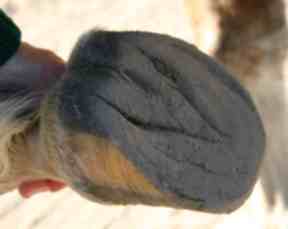
I trim my horses with a "mustang
roll", but not all rock
crunching bare feet need to
be rolled.
There may be an ideal shape
for most conditions, but many
shapes are possible.
 |
I'm
not showcasing my horses on
these pages intentionally.
This isn't about me or what
I do. This page is about all
horses and their potential
to be supremely sound.

|
| Cagey
& Robbie |
 |
Cagey is a 10 year old Arab
who had the good fortune to
grow up half wild in the foothills
above Livermore California.
His breeders strategy was to
breed her mares, turn them out
on a few hundred acres, gather
them for worming, vaccinations,
vet care and foaling.
The mares and foals were again
turned out to pasture until
the foals were 3 to 4 months
old, when they were again brought
in and essentially round penned
as a herd, taught the essentials
of natural horsemanship. There
were handled a bit, then turned
out again to mature.
Danielle had purchased Cagey's
sister 14 years ago, and this
mare, Alyah, had such a wonderful
calm, quiet nature that she
wanted a sibling. Well... they
had the same sire, but Mr. Cagey
was anything but calm and quiet!
Danielle found herself becoming
quite the Natural Horsemanship
enthusiast trying to keep this
fellows feet on the ground for
his first few years!
Eventually Cagey matured into
an awesome almost bomb proof
trail horse. Danielle tried
shoeing him, but the farrier
said his feet were too hard
to trim, so wait until he wears
them down and then he'd nail
shoes on. After thinking about
this - and trying to wear his
feet down unsuccessfully - Danielle
decided to skip the shoes. |
 |
 |
 |
| |
 |
|
 |
............ |
 
|
| |
|
..... |
| |
|
| |
|
|
... |
| |
|
| Tinker |
 |
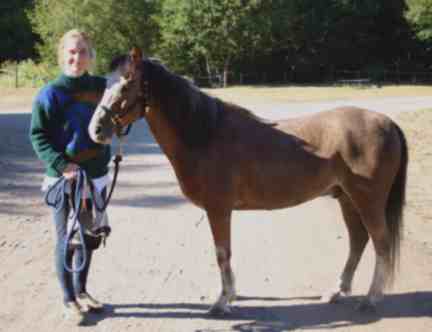
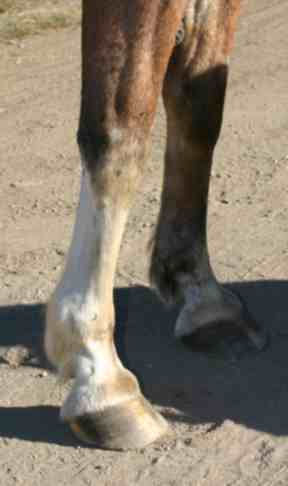
Tinker is an almost 20 year old Welsh pony who is Deb Weathers favorite horse to ride. Don't let his size deceive you! This is an Equine to be reckoned with!
Tinker easily does 15 to 20 mile trail rides at top speed, and blows the socks off of Arabs and TBs, and he has ALWAYS been barefoot!
He has legs that are never swollen or stocked up, and hooves that stand up to any terrain.
|
 |
|
 |
 |
 |
 |
| |
|