|
| The
Natural Hoof is All About Movement
|
|
The robust hoof shape needed
for today's riding is modeled
after the mustang hoof found
on horses wandering in hard,
rocky areas like Nevada and
Arizona.
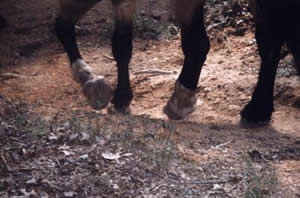
In this environment, the hoof
is worn by the horses' constant
movement. The edges of the hoof
from the toe to the "quarters"
(the sides of the hoof wall
at the base of the hoof) become
rounded by loose soil &
rock. These rounded edges enhance
stability in off-road conditions,
deflect rocks & dirt, &
enhance traction.
|
 |
 |
|
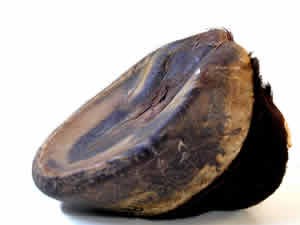
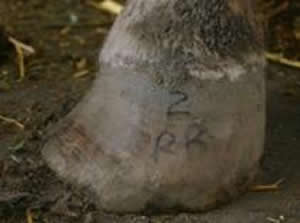
The term Mustang Roll refers
to this rounded edge, a characteristic
that ultimately shapes the rest
of the hoof with movement.
|
|

|
|
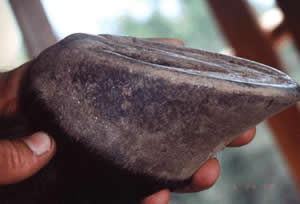
The "quarters" take
on a scoop-shape that accentuates
traction, absorbs concussion,
& allows loose matter to
escape to the sides of the hoof
as the hoof descends in a weight
bearing stage.
A hoof shaped by a loose rock
environment has a pronounced
scoop in the sides, a hoof shaped
by work on flat surfaces (like
carriage horses) have minimal
scoop.
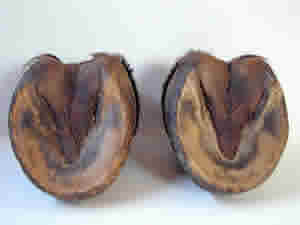
The sole on a natural hoof
becomes concave towards the
frog; the amount is dependent
on breed & conditioning.
|
 |
The sole has a hard callous, particularly
at the edges, because the sole
is weight bearing, particularly
when the hoof expands on impact
to absorb concussion & increase
traction.
The heel/bar junction at the
back of the natural hoof is
also calloused & shiny.
The heel bulbs & frog are
tough & expand to absorb
concussion & increase traction.
In soft, wet environments,
abrasion doesn't occur easily
so the natural hoof wall flair's&
chips off, the frog gets soft
& the dead sole becomes
white & chalky so that minimal
activity will result in shedding.
When living conditions don't
include dozens of miles of movement
over rock & dirt each day,
trimmers can shape a natural
hoof manually, and riders then
finish the trim by riding over
such terrain, or by providing
a hoof-building environment
that includes rock, pea gravel
or other abrasive materials.
|
|
A un-maintained hoof will begin
to flair, chip, crack, &
flake in its attempts to shed
excess wall & remain sound.
When a shod hoof has cracks,
white line separation, flair,
coronet distortion & chipping,
the hoof wall is trying to get
to a natural length.
|
 |
| |
|