 |
HealthyHoof.comHoofcare & Information for Barefoot SoundnessLinda Cowles Hoof Care - Serving the greater SF Bay Area and Northern California |
 Services
ArticlesCase
Studies
Links
Services
ArticlesCase
Studies
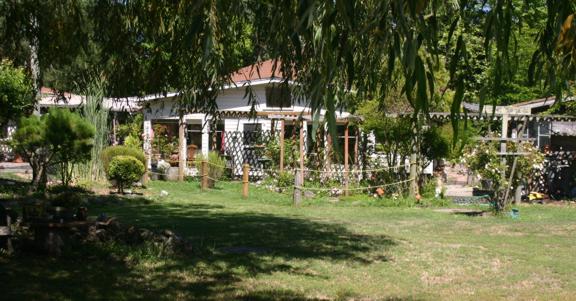
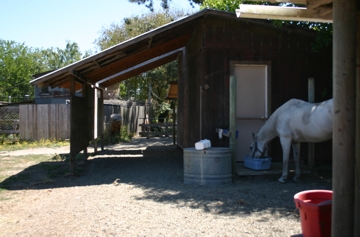
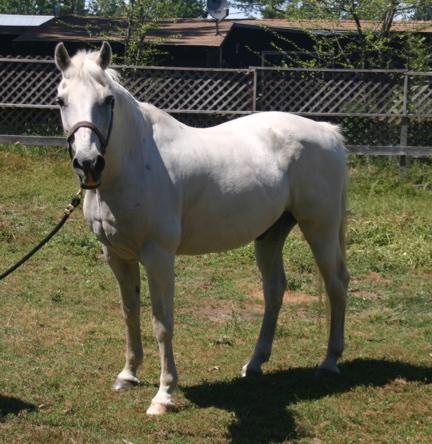
LinksNickyGuess how old he is...(There are great shots of a hoof that's had milt laminitis at the end of the article.) 6/2005 Thirty year old Arab cross Nicky has lived a great life, all of it barefoot. He's lived almost all of those 30 years with Millie Ravano, who provides two environments for him. He has a private paddock with shaded loafing areas, and he's also free to roam the yard with Millie's other animal friends. I was contacted in May 2005 by Millie. Her farrier was providing a good "pasture trim", essentially nippering the wall so that it was slightly longer than the sole and rasping the edges lightly to remove any edges that would snag. Nick's feet were well balanced, however just 3 weeks after his last trim, his hoof wall was flared, distorted under the weight of 1000 pound Nicky. As his hoof wall flared, the lamina spread apart which allowed bacteria to gather in the superficial cracks. These cracks concerned Millie, who worried that they may deepen and spread. She felt a mustang type trim would be a better option.
|
Nicky... young at 30 years old. |
|||
|
||||
 |
||||
|
||||
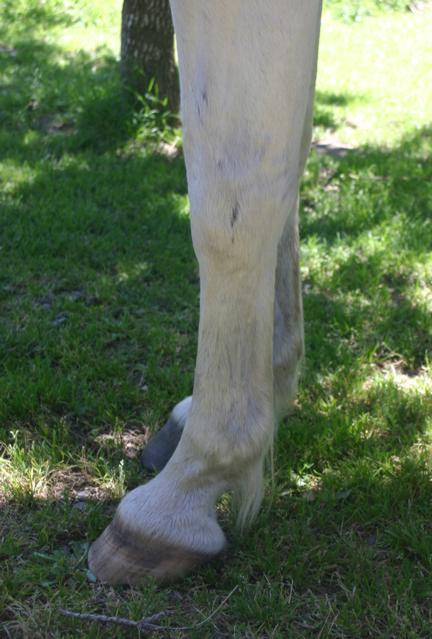 |
Great LegsThe first thing I noticed about Nick were his great legs! Millie told me how old he was, more than 30,and I shook my head, amazed. Part of the reason Nicks legs look so wonderful is the fact that he's never had shoes, so the stresses of imbalance and concussion haven't left behind the wind puffs, inflamed joints, ring bone and side bone that we usually see on horses this old. The other reason is that he's been very lightly used. Millie didn't start riding him until a few years ago, and their riding is done at home.
|
|||
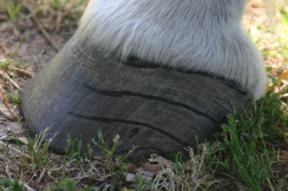
Above: Even
slight wall flair causes distortion
and crevasses for bacteria. |
||||
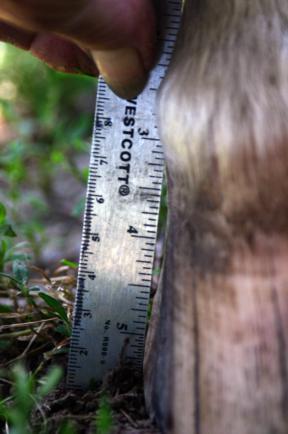
Three weeks after a "pasture" trim, Nick had more than 1/4 inch of wall below his sole. From her reading reading on barefoot horses, Millie had learned that horses support their weigh on their soles as well as the walls, and the logic of this increased her concern with Nick's long wall and superficial cracks. Nick's feet weren't horrible, but Millie knew they could be better. I drew lines on Nicks feet, showing Millie that he was well balanced laterally. Most of his sole had become loose and powdery in it's attempts to shed. When a horse with balanced feet walks on his sole, the combination of wall contraction and expansion and the sole grinding against the footing rubs old sole off and polishes the viable sole into a shiny callous. Nicks heels also started to become slightly under run as they lengthened. Under run heels are easy to fix, particularly in the early stages. A heel is called "under run" when the horse stops walking on the bottom of the heel and begins to walk on the back of the heel wall. |
|
|||
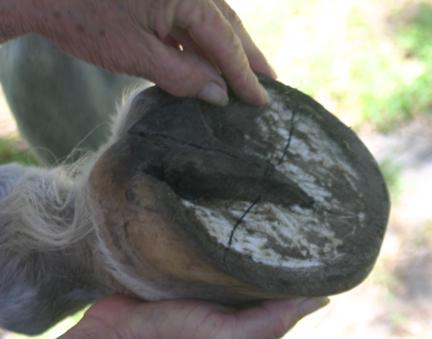 |
Many people feel that under run heels are "too short" because, as they stretch towards the toes, the heels become progressively weaker and are flattened by the weight of the horse. This flattening allows the heel bulbs to remain close to the ground where they need to be, but the center of balance is transferred farther forward as a result. Hoof wall is meant to bear vertical weight and resist lateral pressure. With under run heels, we ask
it to to bear lateral weight
(as the horse begins to walk
on the back of the hoof wall)
and resist vertical pressure
(when sheering occurs as the
horse weights and un-weights
each foot). To "fix" an under run heel, shorten the heel with a hoof knife by moving the heel buttress (the part of the hoof the horse should walk on) to the back of the foot where it belongs. Done correctly, an under run heel can be fixed in four to six weeks. Hooves are living tissue, very similar to skin or human nails. The hoof wall is composed of tubules and lamina connected in a way that allows them to move as the hoof expands and contracts, as the hoof is weighted and un weighted. This flexible structure also allows the fibers to shift in a vertical direction. Irregular growth, wear or trimming results in curved growth rings and coronet bands. A hoof *isn't* like a chunk of dried wood, unable to change. The hoof actively attempts to shed worn out or unnecessary material, such as hoof wall that extends beyond the level of the sole, the old sole and worn out frog.
|
|||
Above: Flexible hoof wall responds to pressure from excess wall length in the "quarters" by pressing wall tubules upward. The curved "quarters" in the above picture relax and straighten within hours of removing excess length. The downward direction of the lines at the rear of the hoof are telltale signs that the heel is beginning to collapse towards the front, a condition called "under run heel" |
||||
Domestic horses usually wear the toe and heel faster than the quarters because they don't travel 20 to 30 miles over loose dirt and rock like wild horses do. Quarter flare is common in barefoot horses with pasture trims and shod horses. Horses with Mustang type trims wear this area more effectively because their wall develops a gentle scoop conformation in the quarters that allows loose rock to escape to the sides, which abrades the wall in the quarters. Excess wall length in the quarters flares the wall outward at the ground. It simultaneously exerts upward pressure that can cause a flare in the coronet band. When the wall is trimmed to the correct length in the quarters, the flare in the wall and coronet band smooth out in hours. Another indication of excess wall length is "white line separation". As the wall becomes too long, the weight of the horse bends the wall away from the hoof, tearing or stretching the attachment, the white line. A good analogy would be a person with long nails trying to use the tips of their fingers to support their weight. The long nails aren't made to support weight, so they bend. If a person was forced to support their weight on long nails, the nails would bend and the bending would pry the nail away from the cuticle. |
||||
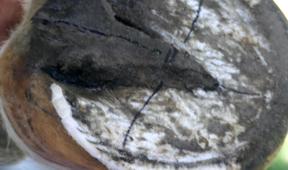
Above: Trimming excess wall reveals a "stretched" white line in the quarters which appears as dark scallops between the sole and the wall. The White Line is a layer of connective tissue that secures the wall to the inner hoof capsule. Sometimes the force that causes white line separation also causes bruising. |
Sound painful? It is! Particularly when the excess wall is in the toe region; the horses attempt to "roll over" a long flared toe pry at the white line in an unshod hoof, and exert a wrenching force on the entire hoof in a shod horse. As I shorten the all in the quarters by nippering off excess and rasping it to the level of the sole, we begin to see distortion in the white line. The distortion occurs as the long wall flares and bends outward under the weigh of the horse, and as the lateral stress skews the unsupported wall as weight shifts above it. After trimming off excess wall, I beveled or rounded the edges of the wall... and forgot to take pictures! Next month I'll show Nicks finished hoof. |
|||
|
||||
Second trim |
||||
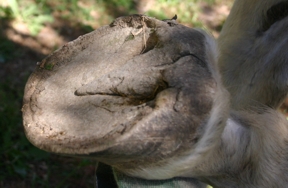
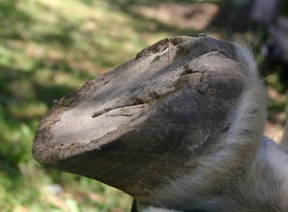
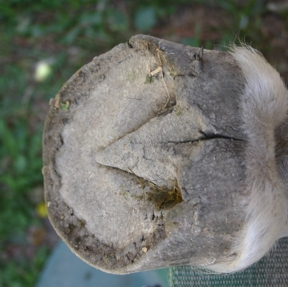
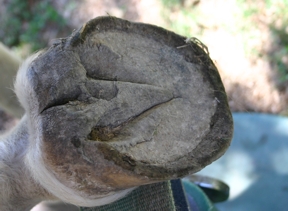
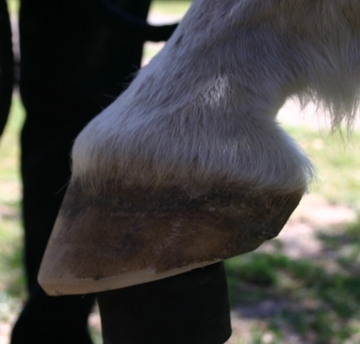
These are pictured from Nick's 2nd trim at 6 weeks. Nick mostly strolls around his equine paradise, so his feet don't get a lot of wear compared to some horses. Something has changed, though; his paddock has had gravel added to it around his shelter and loafing area in preparation for winter, and his feet look great as a result. It's a perfect time for a trim. As you can see in the pictures below, the wall is still tightly attached to the hoof . If we had waited a week or two longer to trim, his wall would begin to flair slightly at the base and the attachment would weaken, resulting in a stretched white line like we had in the setup trim. |
||||
 |
 |
|||
 |
 |
|||
This trim was simple on all four feet. The bars are slightly laid over, but I try not to touch the bars unless they look like they are presenting a problem. The resulting trim, below has a generous bevel on a 1/8 inch of wall. |
||||
 |
|
|||
 |
||||
December 23, 2005 |
||||
|
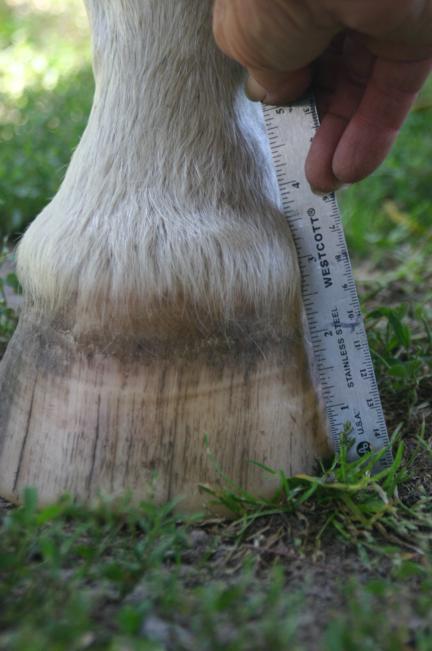
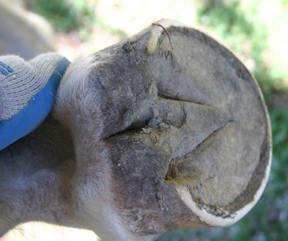
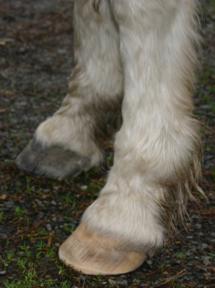
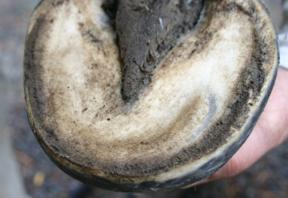
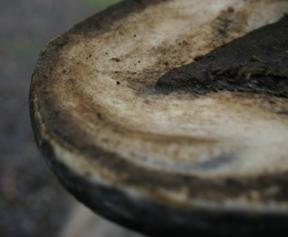
When I went by to trim Nicki, his owner was a bit on the blue side... Nick's hay had changed, and while he had been eating fine but had loose bowels, and had gotten grumpier. He hadn't had a temperature and every thing else looked normal, but she wasn't having any luck getting his stools to firm up. Millie had called the vet, tried probiotics and had gotten him the type of hay he had before. When I looked at the soles of his feet, he had crescent shaped sole ridges in the toe. I felt for heat in the wall and a pulse, and everything looked normal. We took pictures and I suggested she call her er vet to get his advice.
|
|||
Serving the greater SF Bay Area & Northern California
Home | Contact Linda | Privacy | About Us